Stick Drift: What It Is and How to Fix It
Your character creeps left while your hands are completely off the controller. That is stick drift — the most common hardware failure in modern gaming. Here is why it happens, how to confirm it with our gamepad test, and every fix from free to soldered.
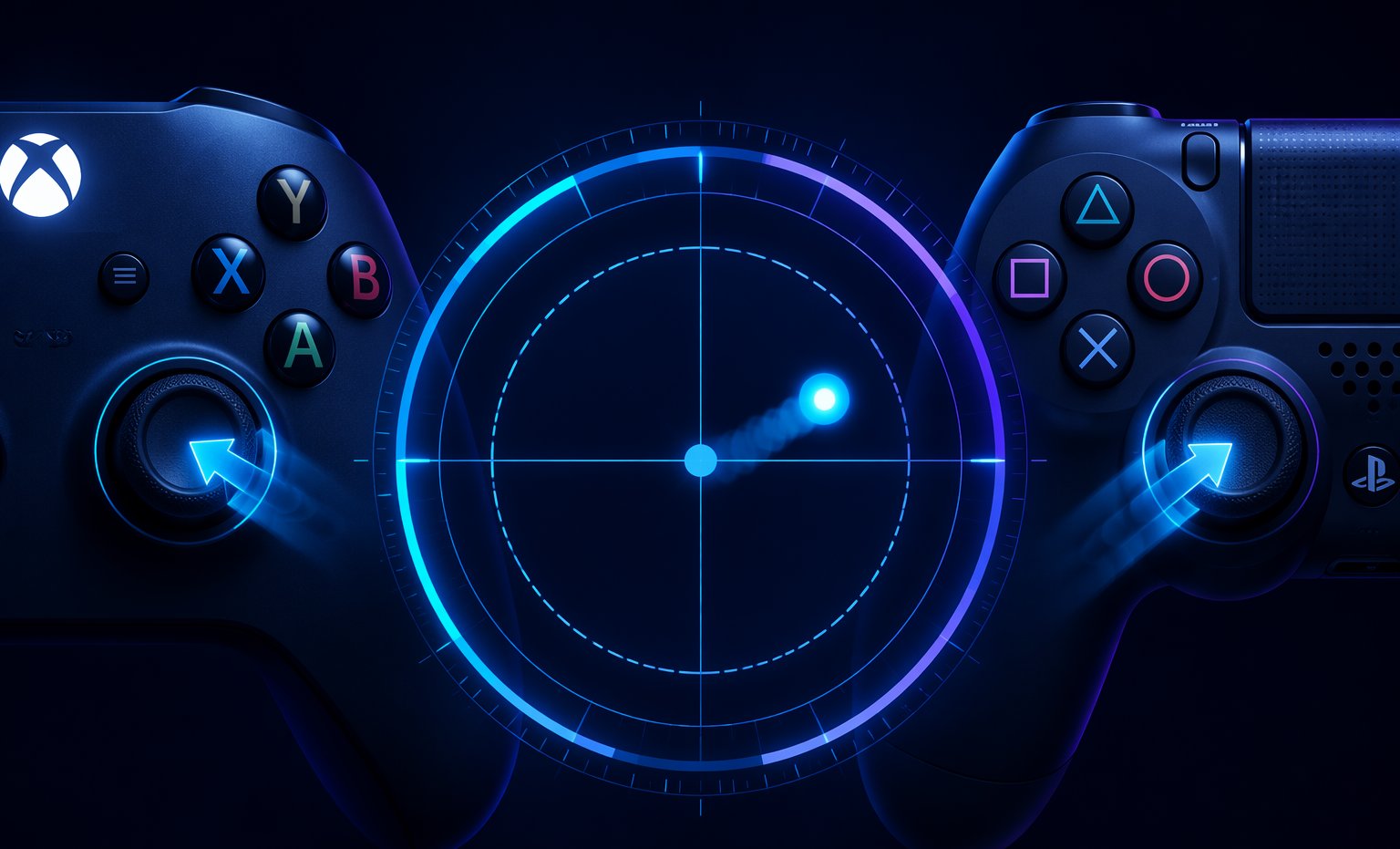
What stick drift actually is
Stick drift is when your character creeps across the screen or your camera slowly pans while your hands are off the controller. The stick is sitting still. The game insists it is moving.
It usually starts subtle — a menu cursor that wanders, aim that will not quite settle — and grows until menus become unusable. It is the single most common hardware failure in modern controllers, and it is not caused by anything you did wrong. Sweat, dust and normal use are enough.
You can confirm it in about ten seconds with our gamepad test, which shows exactly what your sticks are reporting, live.
The physics: a wiper on a resistive track
Inside almost every analog stick module sit two potentiometers, one per axis. Each potentiometer is a metal wiper sliding across a curved resistive track. The wiper's position changes the resistance, the resistance changes the voltage, and the voltage tells the console where the stick is.
Here is the failure: the contact is physical. Every movement grinds the wiper against the track by a microscopic amount. Stick modules are typically rated for around one to two million cycles — which sounds like a lot until a competitive player logs several hours a day.
Dust, skin oil and wear debris collect near the center of the track, exactly where the stick spends most of its life. The resistance at center drifts, the resting voltage is no longer zero, and the console faithfully reports movement that is not happening.
How drift became a scandal
Joy-Con drift turned a hardware quirk into a consumer revolt. Switch owners began reporting drift within months of the 2017 launch, and by 2019 class-action lawsuits were filed in the US. Nintendo eventually apologized and launched a free repair program — no receipt, no warranty check, just send the Joy-Con in.
It was never just Nintendo. The PS5's DualSense and Microsoft's Xbox controllers use potentiometer stick modules from the same supplier ecosystem — ALPS Alpine parts — and both companies have faced their own drift complaints and lawsuits.
The scandal had one useful side effect: millions of players learned to diagnose drift instead of blaming their aim.
Hall effect and TMR: the fix going mainstream
The industry's answer is to stop touching things. Hall effect sticks replace the wiper-and-track with a magnet and a sensor that reads the magnetic field. Nothing makes contact, so nothing wears out. TMR — tunneling magnetoresistance — sticks are the newer, more sensitive cousin now arriving in current hardware.
GuliKit popularized Hall effect sticks in third-party controllers and 8BitDo made them standard on mid-range pads. Between 2024 and 2026 the technology finally started showing up in first-party and pro-tier controllers too. If you are buying a controller in 2026, magnetic sticks are the single feature most worth paying for.
How to test for drift in your browser
Connect your controller by USB or Bluetooth, open the gamepad test, and press any button so the browser picks it up. Then put the controller down and watch.
- Rest position: both stick axes should sit at or very near zero. A resting value that holds away from center, or slowly wanders, is drift.
- Deadzone check: nudge the deadzone slider up until the resting indicator holds still. The size of deadzone you need is the size of your problem.
- Full sweep: push each stick in slow circles and check the axes track smoothly to the edges with no jumps or dead spots.
- Buttons and triggers: while you are here, press everything. Trigger values should sweep smoothly from 0 to 1.
Deadzones hide drift — at a price
Every drift workaround in game settings is the same trick: raise the deadzone so the game ignores small stick inputs. It works — the ghost movement stops. But a deadzone ignores real input too, and a stick you must push 15% before the game notices is a stick with 15% less precision.
Treat deadzones as a diagnostic and a temporary patch, not a cure. If you need a bigger deadzone every few months, the module is wearing out.
Every fix, ordered by effort
- Recalibrate (free, 2 minutes). Switch, PlayStation, Xbox and Steam all offer stick calibration. It re-centers the zero point and fixes minor offset drift.
- Clean it (nearly free, 10 minutes). A few drops of isopropyl alcohol or contact cleaner into the gap around the stick base, then rotate the stick for 30 seconds. This washes debris off the track and fixes a surprising share of cases.
- Use the warranty or repair program (free, slow). Nintendo still repairs drifting Joy-Cons free in many regions, and Sony and Microsoft cover drift under standard warranty.
- Replace the stick module (cheap, skill varies). Potentiometer modules cost a few dollars, and Hall effect upgrade modules exist for Joy-Cons and some other pads. Some controllers clip apart easily, others need soldering — check a teardown for your exact model first.
One last fact for perspective: drift matters enough that speedrunners re-verify controller inputs before record attempts. A single wandering axis can invalidate a run that took hundreds of hours — so they test first. You should too.
The bottom line
Stick drift is physics, not bad luck: a wiper grinding a track until the numbers lie. Test your controller, try recalibration and a clean before spending anything, and when it is time to replace — buy magnetic. Your aim will thank you.
Ready to check your own gear?
Gamepad TestFrequently asked questions
How do I know if my controller has stick drift?
Put the controller down with a stick-test page open. If either axis shows movement away from center while untouched — or slowly wanders — that is drift. Our gamepad test shows it in seconds.
Can stick drift be fixed without opening the controller?
Often, yes. Recalibration fixes offset drift, and isopropyl alcohol or contact cleaner worked into the stick base washes debris off the potentiometer track. Try both before buying parts.
Does Nintendo still repair Joy-Con drift for free?
As of 2026, Nintendo has continued its free Joy-Con drift repair policy in many regions, even out of warranty. Check the support page for your country before paying anyone.
Are Hall effect sticks really drift-proof?
They use magnets instead of physical contact, so there is no resistive track to wear out — the main cause of drift is gone. They can still have centering or calibration quirks, but classic wear-based drift is effectively eliminated.
Is stick drift covered under warranty?
Usually yes — drift is treated as a defect, and standard one-year warranties from Sony, Microsoft and Nintendo cover it. Nintendo's free Joy-Con repair program goes even further.